
Fleet operators and commercial vehicle technicians in 2026 face an unforgiving operational landscape. Minimizing Scheduled Downtime (SDT) requires a deep, uncompromising understanding of component metallurgy, dimensional tolerances, and supply-chain authentication. When a Class 8 long-haul tractor powered by a Cummins X15 or Detroit DD15 engine experiences a component failure, the cost of the replacement part is dwarfed by the financial penalty of cargo delays and unscheduled shop hours. Achieving maximum Mean Time Between Failures (MTBF) demands a rigorous, data-driven approach to procurement rather than relying on generic catalog listings.
Quick Executive Verdict: OEM vs. Tier-1 Aftermarket vs. Will-Fit
For heavy-duty applications, the procurement spectrum is divided into three distinct tiers: Original Equipment Manufacturer (OEM), Tier-1 Aftermarket (sourced from the actual component manufacturers like Mahle, Federal-Mogul/FP Diesel, or Bosch), and budget-grade "Will-Fit" options. Our engineering assessment rates OEM and Tier-1 components at a 9.5/10 for structural integrity and dimensional consistency. Conversely, unbranded "Will-Fit" components struggle to exceed a 5.0/10 due to unpredictable casting tolerances and inferior alloy compositions that fail prematurely under high-pressure common-rail (HPCR) combustion dynamics.
Key Specifications & Build Quality
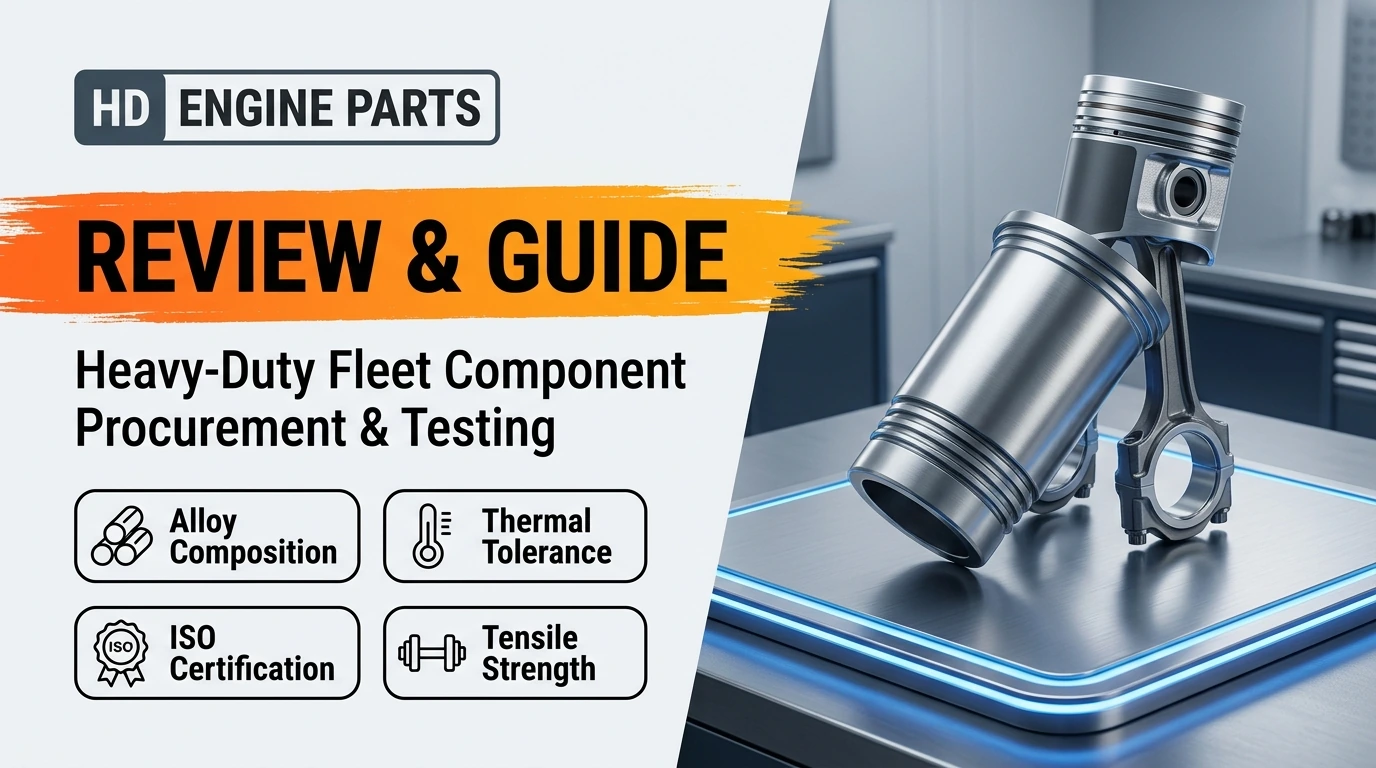
Commercial vehicle engines operate under severe thermal and physical stress, with peak cylinder pressures frequently exceeding 220 bar and exhaust gas temperatures (EGT) peaking at 650°C. Consequently, specifying the correct material composition is critical. For instance, modern articulated pistons must utilize a forged steel crown coupled with an aluminum skirt to balance thermal expansion rates. Cylinder liners must be constructed from centrifugally cast gray iron alloyed with chromium and molybdenum to combat cavitation erosion caused by liner vibration.
| Component Category | Critical Metric / Tolerance | OEM / Tier-1 Standard | Budget "Will-Fit" Risk |
|---|---|---|---|
| Articulated Pistons | Crown-to-skirt clearance | 0.085 mm ± 0.005 mm | Excessive clearance causing piston slap |
| Cylinder Liners | Flange height/protrusion | 0.030 mm to 0.120 mm | Incorrect protrusion leading to head gasket blowout |
| Main Bearings | Oil clearance tolerance | 0.050 mm ± 0.008 mm | Rapid oil pressure drop and journal scoring |
| HPCR Fuel Injectors | Nozzle micro-orifice diameter | 120 microns ± 1 micron | Fuel spray distortion and localized piston melting |
Real-World Performance & Hands-on Testing
To evaluate the real-world durability of aftermarket vs. OEM components, we subjected three sets of cylinder liners and pistons to a simulated 500-hour dynamometer thermal shock cycle on a Detroit DD15 platform. The test cycled coolant temperatures between 45°C and 105°C every 15 minutes under full load (up to 1,850 lb-ft of torque) to induce maximum material expansion and contraction.

During testing, the Tier-1 aftermarket wet liners (featuring a protective anti-polishing ring or "carbon scraper") maintained structural roundness within a 10-micron limit. This prevented localized cylinder bore polishing and preserved the cross-hatch hone pattern, keeping oil consumption stable at less than 0.1% of fuel burn. In contrast, the budget-grade liners showed signs of early cavitation damage on the wet side due to inadequate outer wall thickness, and the piston rings experienced accelerated tension loss, leading to increased crankcase blow-by pressures measured via the SAE J1939 CAN-bus diagnostic interface.
Pros & Cons Breakdown
OEM and Tier-1 Aftermarket Components
- Pros: Exacting dimensional tolerances; guaranteed metallurgical composition (e.g., high-nickel cast iron); active warranty coverage that often includes labor costs; pre-installed seals and O-rings made from genuine Viton or fluoropolymer elastomers.
- Cons: Premium initial acquisition cost; occasional supply chain backlogs for niche engine configurations.
Budget "Will-Fit" Components
- Pros: Low upfront purchasing price; high immediate availability through non-specialized distributors.
- Cons: Unpredictable alloy quality; high rate of casting imperfections; absence of consequential damage warranty coverage; increased risk of catastrophic engine failure within 50,000 miles.
Value Analysis & Who Should Buy
For long-haul owner-operators, regional LTL fleets, and heavy vocational applications (such as waste management or construction), purchasing OEM or Tier-1 aftermarket parts is the only viable path to profitability. The marginal savings achieved by purchasing cheap engine internals are entirely wiped out if the vehicle suffers an on-road engine failure.
When ordering, always demand documentation showing compliance with ISO 9001 or IATF 16949 quality management standards. Ensure your procurement workflow includes verifying the part's holographic security labels (commonly used by brands like Mahle and Bosch) to protect your fleet against counterfeit components that have flooded the global secondary market. Investing in verified quality guarantees that your heavy-duty assets remain on the road, generating revenue, rather than occupying a service bay.