
Procuring Original Equipment Manufacturer (OEM) parts for enterprise commercial fleets has evolved from simple transactional purchasing into a high-stakes operational discipline. With supply chain volatilities, strict corporate emissions benchmarks, and the staggering cost of unscheduled vehicle downtime—often exceeding thousands of dollars per truck per day—fleet directors must establish systematic sourcing protocols. Relying on fragmented supplier orders or ad-hoc dealer counter purchases routinely drains operating budgets and introduces counterfeit components into critical transport assets.
Prerequisites and Technical Sourcing Checklist
Before issuing commercial purchase orders or entering Master Service Agreements (MSAs) with distributors, fleet asset managers must compile core fleet telemetry and procurement prerequisites:
- Complete Fleet Asset Registry: Accurate Year, Make, Model, Engine Serial Numbers (ESN), and full 17-digit Vehicle Identification Numbers (VIN) cross-referenced across your asset tracking software.
- Enterprise Maintenance Software (CMMS/FMS): Fully integrated Fleet Management System capable of logging mean-time-between-failures (MTBF) and mapping inventory consumption.
- Supplier Due Diligence Dossier: Documented ISO 9001 certifications, authorized Tier-1 or direct-OEM distribution licenses, and verified manufacturer warranty support networks.
- Baseline Telematics Data: Component wear benchmarks based on real-world duty cycles, route topography, and gross vehicle weight ratings (GVWR).
Chronological Step-by-Step OEM Procurement Guide
Step 1: Audit Fleet Duty Cycles and Categorize Inventory Criticality
Begin by dividing your parts demand into three distinct velocity bands: High-Turn Consumables (filtration, brake friction, fluid service items), Critical Operational Assemblies (ECM modules, steering gears, air brake valves, turbochargers), and Structural or Collision Hardware. Cross-reference vehicle telematics to isolate severe-duty assets requiring earlier component replacements. Establishing this taxonomy prevents over-ordering non-critical spares while ensuring high-consequence line items receive direct factory supplier priority.
Step 2: Consolidate OEM Part Numbers via Primary Build Sheets
Never rely solely on generic catalog listings. Retrieve the original OEM factory build sheets using individual vehicle VINs and engine serial codes. Major heavy-duty manufacturers alter sub-assembly specifications mid-production run, meaning two identical models from the same manufacturing year may utilize divergent wiring harnesses, NOx sensors, or hydraulic fittings. Standardize internal SKU catalogs around verified OEM part revisions and superseded component identifiers.
Step 3: Establish Direct Tier-1 Distribution Contracts
Bypass tertiary local jobbers by negotiating Master Parts Agreements directly with authorized OEM master distributors or Tier-1 component suppliers (such as Bendix, Meritor, Cummins, or Eaton). Leverage your collective fleet mileage and annual consumable volume to secure tier-bracketed pricing matrices. Ensure the contract incorporates strict Service Level Agreements (SLAs) dictating guaranteed fulfillment timelines, national freight consolidation options, and core-return logistics.
Step 4: Implement Vendor-Managed Inventory (VMI) Protocols
For operations maintaining centralized regional maintenance hubs, deploy Vendor-Managed Inventory (VMI). Under this operational model, your contracted OEM distributor maintains mutually agreed safety stock levels directly within your parts room. You only absorb inventory costs once a barcode is scanned against a specific internal repair order (RO), dramatically curbing upfront capital expenditures while eliminating parts-related bay downtime.
Step 5: Standardize Receipt Validation and Barcode Ingestion
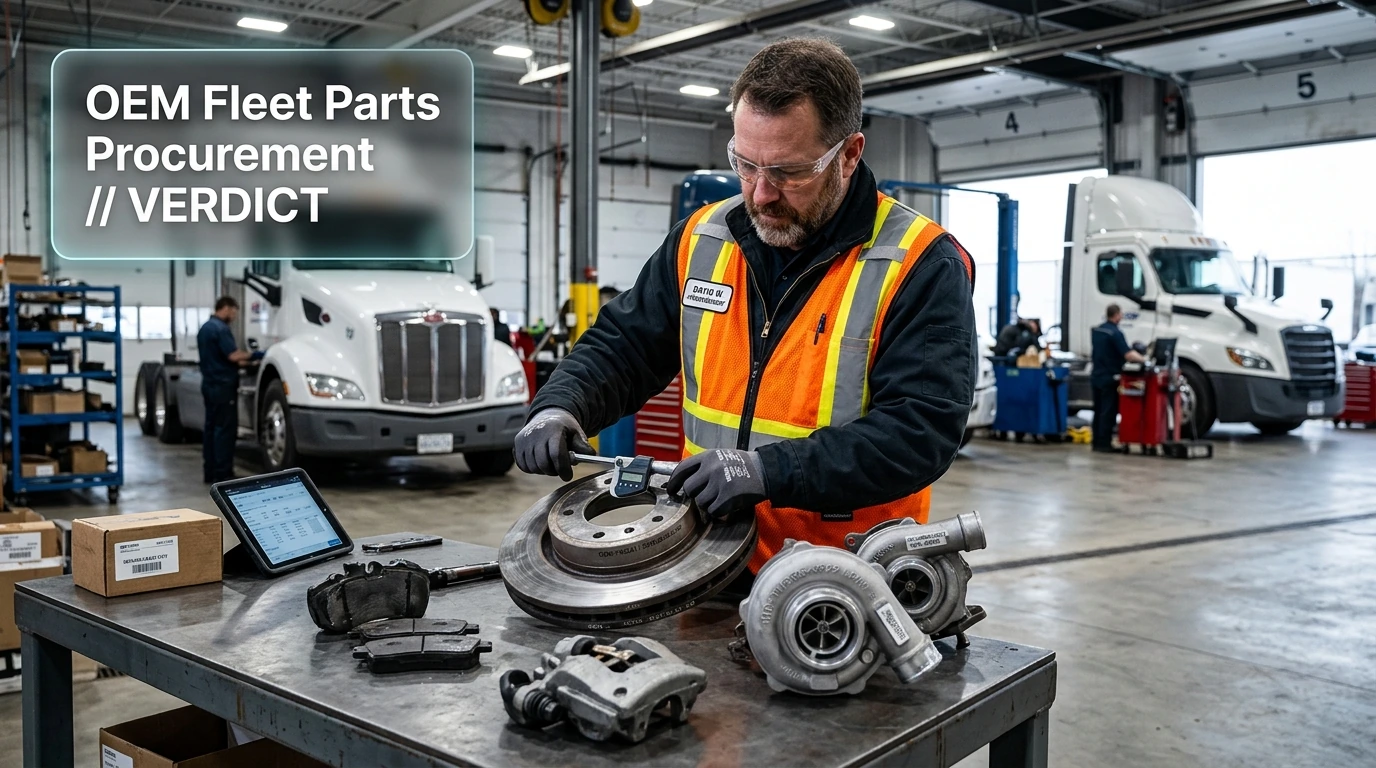
Inspect incoming deliveries at the loading dock before entering inventory into your CMMS. Validate holographic security labels, molded manufacturer logos, and precision packaging markings against known factory authentication standards. Scan serial numbers directly to your fleet system to ensure lot traceability should a technical service bulletin (TSB) or manufacturer campaign emerge later in the operational lifecycle.
Common Fleet Sourcing Pitfalls to Avoid
- Chasing Gray-Market Discounting: Procuring heavily discounted components through unauthorized web portals often introduces reconditioned parts masquerading as factory-new OEM inventory.
- Overlooking Core-Return Windows: Failing to track and return rebuildable cores (alternators, injectors, brake calipers) within supplier deadlines forfeits significant deposit credits, eroding parts margins.
- Ignoring Cross-Referenced Tier-1 Branding: Forgetting that commercial chassis builders rarely manufacture every subcomponent internally. Purchasing directly under the Tier-1 component builder label (e.g., purchasing a Haldex valve directly rather than through truck dealership branded boxes) yields identical OEM quality at reduced fleet acquisition costs.
- Neglecting Software and Calibration Bundles: Ordering mechatronic components—such as automated manual transmission actuators or lane-departure sensors—without securing the associated OEM software flashing licenses leaves bays stalled.
Post-Implementation Verification Checklist
Evaluate your parts procurement workflows quarterly using these verifiable metrics:
- Unscheduled Bay Idle Time: Zero repair delays attributable to missing critical Tier-1 components.
- Warranty Recovery Ratio: Greater than 95% recovery rate on failed components covered under OEM manufacturer provisions.
- Inventory Obsolescence Rate: Under 3% total stagnant or unusable inventory value across active terminal facilities.
- Core Deposit Return Rate: 100% account reconciliation on all rotating rebuildable core credits within 30 days of swap.
Frequently Asked Questions
What is the functional difference between OEM and OES fleet parts?
OEM (Original Equipment Manufacturer) components are built by the company that manufactured the vehicle or its direct sub-assembly partner, bearing the truck builder's nameplate. OES (Original Equipment Supplier) parts are produced by the third-party tier-1 supplier (such as Bosch or Dana) that supplied the assembly line, offering identical structural metallurgy and technical tolerances, often at a lower packaging markup.
How can enterprise fleets combat counterfeit commercial parts?
Establish strict single-tier sourcing chains, requiring supply vendors to maintain documented franchise authorization agreements. Require serialized traceability and inspect packaging for laser-etched matrix codes, tamper-evident seals, and specific manufacturer typography.
Does installing aftermarket parts automatically void an enterprise chassis warranty?
Under commercial vehicle law, a manufacturer cannot void an entire vehicle warranty solely due to an aftermarket part unless they prove that specific component directly caused the downstream failure. However, for complex mechanical assemblies, proving absence of liability is difficult, making authentic OEM components the safest operational choice for assets under active factory coverage.